Sold out
Loading product…
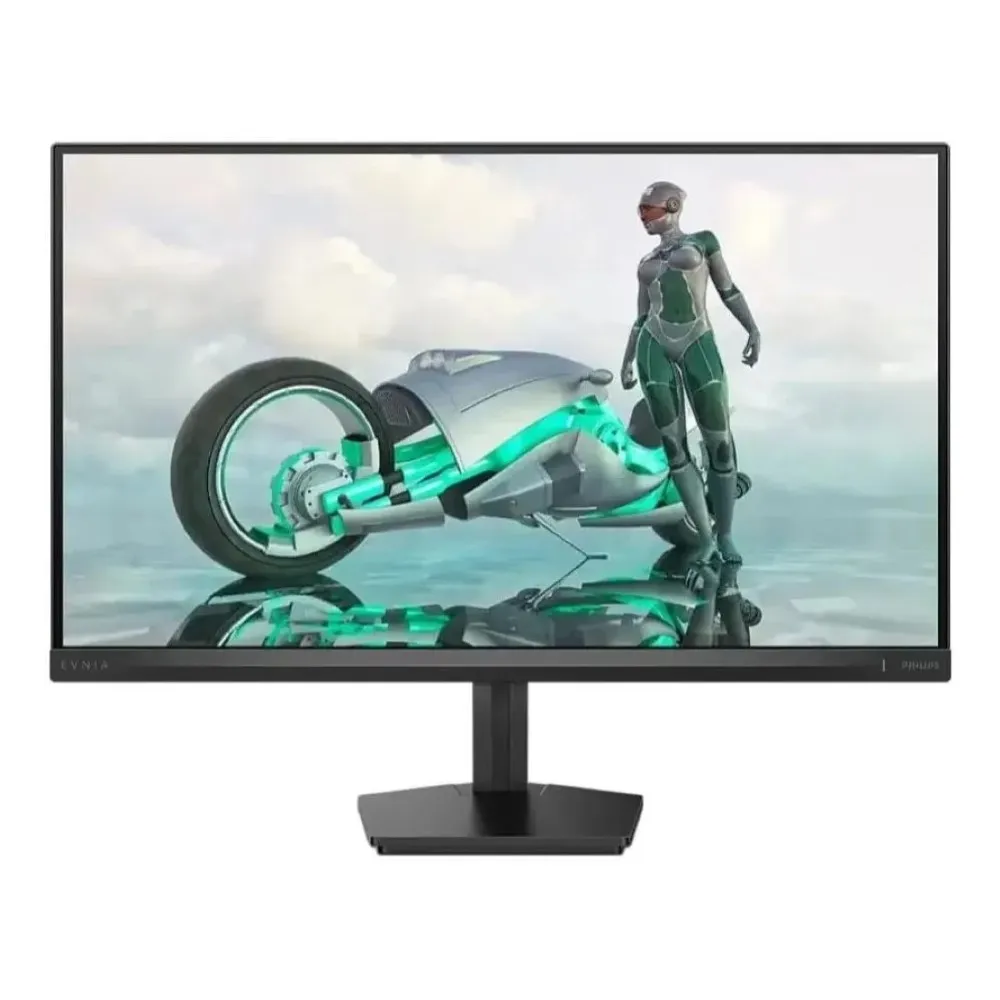
Item DC-5558
Sold out
| Brand
Name of the company-manufacturer. |
Philips |
| Series
Name of the series, which the model belongs to. |
Evnia 3000 |
| Model
Designation of the model. |
27M2N3500UK |
| Model alias
Other known designations of the model. |
Evnia 27M2N3500UK 27M2N3500UK/69 27M2N3500UK/71 27M2N3500UK/75 |
| Model year
The year in which this model was announced. |
2025 |
| Size class
Size class of the display as declared by the manufacturer. Often this is the rounded value of the actual size of the diagonal in inches. |
27 in (inches) |
| Diagonal
Approximate diagonal size of the display. If the manufacturer does not provide such information, the diagonal is calculated from the width and height of the screen. |
684.7 mm (millimeters) 68.47 cm (centimeters) 26.9567 in (inches) 2.2464 ft (feet) |
| Width
Approximate width of the display. If the manufacturer does not provide such information, the width is calculated from the diagonal and the aspect ratio. |
596.736 mm (millimeters) 59.6736 cm (centimeters) 23.4935 in (inches) 1.9578 ft (feet) |
| Height
Approximate height of the display. If the manufacturer does not provide such information, the height is calculated from the diagonal and the aspect ratio. |
335.664 mm (millimeters) 33.5664 cm (centimeters) 13.2151 in (inches) 1.1013 ft (feet) |
| Panel manufacturer
Name of the manufacturer of the display panel. |
BOE |
| Panel type
There are various panel technologies. Each has its own specific features - viewing angles, color reproduction, response time, brightness/contrast, production cost, etc. The image quality depends directly on the type of the display panel used. |
IPS |
| Panel bit depth
The most widely used panels are those with 6, 8, and 10 bits for each of the RGB components of the pixel. They provide 18-, 24-, and 30-bit color, respectively. |
10 bits (8 bits + FRC) |
| FRC
Frame Rate Control (FRC) is a method, which allows the pixels to show more color tones. With quick cyclic switching between different color tones, an illusion for a new intermediate color tone is created. For example, by using FRC, a 6-bit display panel is able to show 16.7 millioin colors, which are typical for 8-bit display panels, and not the standard 262200 colors, instead. There are different FRC algorithms. |
Yes |
| Colors
The maximum number of colors, which the display is able to reproduce, depends on the type of the panel in use and color enhancing technologies like FRC. |
1073741824 colors 30 bits |
| Aspect ratio
The ratio between the horizontal and the vertical side of the display. Some of the standard and widely used aspect ratios are 4:3, 5:4, 16:9 and 16:10. |
1.778:1 16:9 |
| Resolution
Information about the number of pixels on the horizontal and vertical side of the screen. A higher resolution allows the display of a more detailed and of higher quality image. |
2560 x 1440 pixels Quad HD (QHD) / 1440p |
| Pixel pitch
The pixel pitch shows the distance from the centers of two neighboring pixels. In displays, which have a native resolution (the TFT ones, for example), the pixel pitch depends on the resolution and the size of the screen. |
0.233 mm (millimeters) 0.0233 cm (centimeters) 0.0092 in (inches) 0.0008 ft (feet) |
| Pixel density
Information of the number of pixels in a unit of length. With the decrease of the display size and the increase of its resolution, the pixel density increases. |
109 ppi (pixels per inch) 42 ppcm (pixels per centimeter) |
| Display area
The percentage of the approximate area, taken by the active part of the screen, to the total front area. |
88.65 % (percent) |
| Backlight
The backlight is the source of light of the LCD display panels. The type of backlight determines the image quality and the color space of the display. There are various backlights such as CCFL, LED, WLED, RGB-LED, and etc. |
W-LED |
| sRGB
sRGB is a color space, developed jointly by Hewlett-Packard and Microsoft in 1996. It is used in different devices such as printers, displays, TV sets, cameras, etc. The sRGB color space covers about 72% of the NTSC color space. |
129.35 % (percent) |
| Adobe RGB (1998)
Adobe RGB (1998) is a color space, developed by Adobe Systems in 1998. It has a wider gamut than the sRGB (mainly in the cyan-green range of colors) and is widely used in professional printing. |
93.8 % (percent) |
| NTSC (1953)
The NTSC (1953) color space is introduced in 1953 by the FCC with the appearance of color television and has a wider gamut than the sRGB. |
108.13 % (percent) |
| DCI P3
DCI P3 is a color space, introduced in 2007 by the SMPTE. It is used in digital cinema and has a much wider gamut than the sRGB. |
96.7 % (percent) |
| Brightness
Information about the brightness of the screen. It is measured in candela per square metre (cd/m²). |
350 cd/m² (candela per square meter) |
| Peak brightness
Often even a higher peak luminance can be achieved under certain conditions. For example, when a smaller area/APL of the display is used for showing a bright object, when a bright object is displayed for a short time, etc. |
450 cd/m² (candela per square meter) |
| Static contrast
The static contrast shows the ratio between the brightest and the darkest color, which the display can reproduce simultaneously, for example, within one and the same frame/scene. |
1000 : 1 |
| HDR
HDR expands the contrast ratio (peak luminance and minimal black levels) and color palette to achieve more details across the whole image - from the darkest parts to the brightest ones, which results in more realistic and life-like image. |
DisplayHDR 400 |
| Horizontal viewing angle
Information about the maximum horizontal viewing angle, within which the image on the screen is of acceptable quality. |
178 ° (degrees) |
| Vertical viewing angle
Information about the maximum vertical viewing angle, within which the image on the screen is of acceptable quality. |
178 ° (degrees) |
| Minimum response time
Information about the minimum amount of time, in which the pixels change from one color to another. Very often the manufacturer provides the response time for transition from grey-to-grey (G2G). |
1 ms (milliseconds) 0.0010 s (seconds) |
| Coating
Information about the type of coating of the display. There are different types of matte and glossy coatings, each of which has its own advantages and drawbacks. |
Anti-glare/Matte (3H) |
| Native 8-bit at 300Hz 8-bit+FRC at 260Hz or lower Response time - 0.3 ms (MPRT - Motion Picture Response Time) Philips Evnia Comfort Blue 4.0 Circular Polarizing Light Panel |
| 3D
Information on whether 3D is supported or not. |
No |
| Horizontal frequency (digital)
The horizontal scan rate/frequency shows the number of horizontal lines, displayed by the monitor per second, when it is plugged to a digital source. |
30 kHz - 470 kHz (kilohertz) |
| Vertical frequency (digital)
The vertical frequency/refresh rate shows how many times in a second the image on the screen is refreshed. |
48 Hz - 300 Hz (hertz) |
| 110V
Permissible voltage tolerance in a 110-volt electric system. |
100 V - 120 V (volts) |
| 220V
Permissible voltage tolerance in a 220-volt electric system. |
220 V - 240 V (volts) |
| Alternating current frequency
Requirement regarding the alternating current frequency in the electric system. |
50 Hz - 60 Hz (hertz) |
| Power consumption (off)
Power consumption in off-mode. |
0.3 W (watts) |
| Power consumption (sleep)
Power consumption in sleep/stand by/suspend mode. |
0.5 W (watts) |
| Power consumption (average)
Average power consumption in standard work mode. |
31.13 W (watts) |
| Width
Width without stand in different measurement units. |
614 mm (millimeters) 61.4 cm (centimeters) 24.1732 in (inches) 2.0144 ft (feet) |
| Height
Height without stand in different measurement units. |
368 mm (millimeters) 36.8 cm (centimeters) 14.4882 in (inches) 1.2073 ft (feet) |
| Depth
Depth without stand in different measurement units. |
60 mm (millimeters) 6 cm (centimeters) 2.3622 in (inches) 0.1969 ft (feet) |
| Weight
Weight without stand in different measurement units. |
3.73 kg (kilograms) 8.22 lbs (pounds) |
| Width with stand
Width with stand in different measurement units. |
614 mm (millimeters) 61.4 cm (centimeters) 24.1732 in (inches) 2.0144 ft (feet) |
| Height with stand
Height with stand in different measurement units. |
463 mm (millimeters) 46.3 cm (centimeters) 18.2283 in (inches) 1.519 ft (feet) |
| Depth with stand
Depth with stand in different measurement units. |
216 mm (millimeters) 21.6 cm (centimeters) 8.5039 in (inches) 0.7087 ft (feet) |
| Weight with stand
Weight with stand in different measurement units. |
4.28 kg (kilograms) 9.44 lbs (pounds) |
| Box width
Width of the package in different measurement units. |
690 mm (millimeters) 69 cm (centimeters) 27.1654 in (inches) 2.2638 ft (feet) |
| Box height
Height of the package in different measurement units. |
420 mm (millimeters) 42 cm (centimeters) 16.5354 in (inches) 1.378 ft (feet) |
| Box depth
Depth of the package in different measurement units. |
141 mm (millimeters) 14.1 cm (centimeters) 5.5512 in (inches) 0.4626 ft (feet) |
| Box weight
Weight of the product with all accessories and packaging in different measurement units. |
7 kg (kilograms) 15.43 lbs (pounds) |
| Stand depth
Depth of the stand in different measurement units. |
216 mm (millimeters) 21.6 cm (centimeters) 8.5039 in (inches) 0.7087 ft (feet) |
| Colors
Information about the colors, in which the specific model is offered to the market. |
Graphite |
| VESA mount
Information about whether there is a possibility for wall mounting according to the VESA Mounting Interface Standard (MIS). |
Yes |
| VESA interface
There are many various interfaces under the VESA standard, which differ in the size of the brackets, the distances between the screw holes and their number. |
100 x 100 mm |
| Removable stand
Information about whether the stand can be dismounted. Usually, this is required for wall mounting. |
Yes |
| Height adjustment
Information about whether the stand allows height adjustment. |
No |
| Landscape/portrait pivot
Some displays have the ability to operate in landscape and portrait mode alike. |
No |
| Left/right swivel
Information whether the display can be swiveled around the stand axis. |
No |
| Forward/backward tilt
Most displays have the ability to be tilted forward and backward as to provide a more comfortable viewing position for the user. |
Yes |
| Forward tilt
Maximum degree of forward tilting of the display. |
5 ° (degrees) |
| Backward tilt
Maximum degree of backward tilting of the display. |
20 ° (degrees) |
| Camera
Information whether the current model has a built-in camera or not. |
No |
| Connectivity
Information about the available connectivity ports, slots and interfaces such as USB, infrared port, SD card slot, audio/video and network interfaces, etc. |
1 x HDMI 2.1 1 x DisplayPort 1.4 1 x 3.5 mm Audio Out |
| High-bandwidth Digital Content Protection (HDCP) |
| Features
Information about additional software features, technologies, functions and services of the model. |
Adaptive-Sync technology Circular Polarization Technology EasyRead Fast IPS Flicker-free technology Low Blue Light Low Input Lag Mega Infinity DCR MultiView Picture-by-Picture Picture-in-Picture Separate Sync SmartContrast SmartImage Game SmartResponse SmartUniformity Smart Crosshair Smart MBR Sync Smart Sniper Stark Shadow Boost |
| Certificates, standards and licenses
List of the standards, certificates and licenses supported/received by the current model. |
CB CCC CE CECP CEL EMF FCC ICES-003 RoHS |
| Operating temperature
The operating temperature shows the safe temperature range (from minimum to maximum), within which the display will function flawlessly. Outside this range it might operate improperly and/or fail entirely. |
0 °C - 40 °C (degrees Celsius) 32 °F - 104 °F (degrees Fahrenheit) |
| Operating humidity
The operating humidity shows the acceptable level of humidity, in which the display will function flawlessly. It sets a lower and an upper humidity level for safe operation and is measured in percentage. |
20 % - 80 % (percent) |
| Operating altitude
The operating altitude shows the maximum admissible altitude, at which the display will function flawlessly. Above this level it might not operate properly and/or might seize to function. |
3657.6 m (meters) 12000 ft (feet) |
| Storage temperature
The storage temperature shows the range from a minimum to a maximum temperature, within which storing of the display is considered to be safe. |
-20 °C - 60 °C (degrees Celsius) -4 °F - 140 °F (degrees Fahrenheit) |
| Storage humidity
The storage humidity shows the lower and upper humidity limit, which ensures safe storage of the display. Storing it outside these limits might damage the display. |
10 % - 90 % (percent) |
| Storage altitude
The storage altitude shows the maximum possible altitude for secure storing of the display. Storing it above this limit may result in damaging the display. |
12192 m (meters) 40000 ft (feet) |
| Accessories
Information about some of the main accessories included in the standard packaging of the current model. |
DisplayPort cable (optional) HDMI cable (optional) |
No reviews yet. Bought it? Tell others what you think.